
The University of Tübingen was awarded the 2025 Baden-Württemberg state Teaching Prize
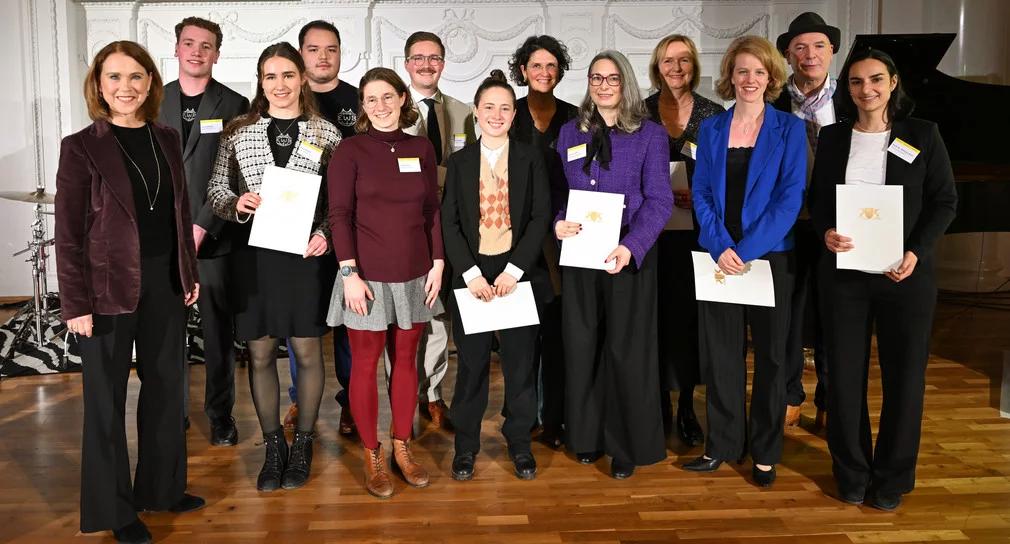
How can you get students excited about a historical, sociological topic? By putting them directly into historical roles, relationships, and social contexts of the respective era.
Professors Dr. Ursula Offenberger, Leonie Holdik, and Dorothee Engbers from the University of Tübingen have achieved this in a unique way: as part of the Master’s seminar Gender and Diversity in the Beginnings of Empirical Social Research, they worked with students to develop and stage a theater project.
The performative teaching and learning project was based on an interdisciplinary Master’s seminar at the Faculty of Economics and Social Sciences during the winter semester 2023/24. It explored the historical and sociological beginnings of empirical social research in the USA.
Participants examined the extent to which women and African Americans made groundbreaking contributions to the development of the field at that time - contributions that were later forgotten, suppressed, or ignored in historiography on the origins of empirical social research.
Although the course designed by Prof. Dr. Ursula Offenberger was primarily historically oriented, it also highlighted contemporary references and parallels to racist and sexist thinking.
From first reading to performance
The first third of the seminar consisted of reading primary and secondary literature in order to familiarize participants with the historical material and to provide them with the necessary background knowledge for understanding the theater manuscript.
The ‘game’ of taking on different perspectives and roles was integrated into the seminar at an early stage. It served the dual purpose of familiarizing participants with the material, putting themselves in the shoes of the historical figures and the era from which the respective texts originate, and preparing them for stage work.
The plot, characters, key scenes, and setting of the stage play were developed collaboratively, with all students participating in the writing process. The highlight of the project was three performances of the play “Drawing Lines. Vom Kampf um gleiche Rechte” in Tübingen, which were well received. The Teaching Prize jury praised the current, innovative, and socially relevant orientation of the theater project and its wide reach.
Good teaching, where motivation, innovation, and commitment are evident, benefits both teachers and students alike, and thus contributes significantly to academic success,” said Minister of Science, Research and Arts Petra Olschowski at the award ceremony. “We are not only shaping professions and education paths; we are shaping our society.”
The project, partly funded by CIVIS through the Open Labs, is to be further developed in the near future across Europe in cooperation with the Alliance's partners. After all, raising awareness of issues such as racism, sexism, and democratic coexistence can make an important contribution to peaceful coexistence not only in Germany but across the continent.
The State Teaching Prize is awarded every two years, to give recognition to the work and commitment of outstanding individuals and their projects at the state's universities. The money offered is earmarked for teaching purposes.
Latest Highlights:
Cutting-edge research at Stockholm University on MOFs, Nobel Prize-Winning Materials
The links between science and beliefs, debated at the amU' Science and Arts Festival 2025
UN warning that drought could be the next pandemic, backed by UofG research