null

Experiencing Discrete Mathematics for Cybersecurity and Resilience

Digital technologies shape almost every aspect of modern life, yet the mathematical foundations behind cybersecurity and societal resilience often remain invisible to the wider public. This CIVIS Open Lab project transformed complex concepts from discrete mathematics into accessible, hands-on learning experiences through interactive games, visual materials and participatory workshops.

Researchers from the University of Salzburg, the University of Bucharest and Universidad Autónoma de Madrid co-created outreach activities that were showcased at science festivals, university open days, international scientific conferences as well as international CIVIS events. By combining expertise from computer science, mathematics, geoinformatics and educational sciences, the project strengthened STEM engagement, promoted digital literacy and encouraged informed participation in an increasingly digital society.
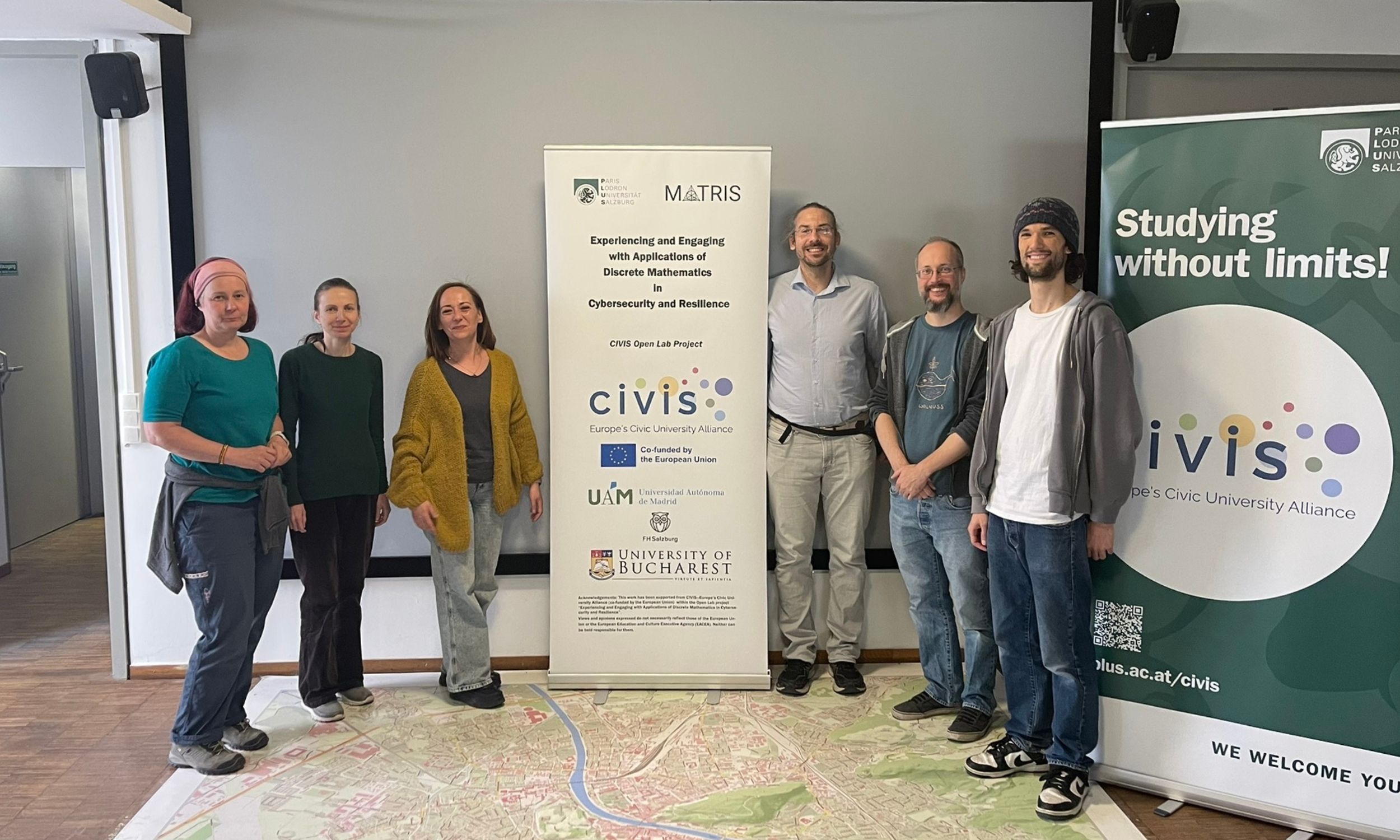
Main Beneficiaries & Social Impact

Main Beneficiaries

The project engaged children, high-school students, university students, academics, researchers and interested citizens through interactive workshops, science festivals and international conferences. Across the timeline of this project, more than 200 school pupils, over 60 additional external participants and numerous academics and students from CIVIS partner universities directly interacted with the project.

Social Impact

Rather than communicating cybersecurity through abstract technical explanations, the project enabled participants to experience mathematical concepts through play, experimentation and discussion. The adaptable outreach materials (including board games) successfully addressed audiences with different levels of prior knowledge, helping participants better understand cybersecurity, disaster resilience and the societal relevance of mathematics. The collaboration also strengthened links between universities, schools, science communication initiatives and the wider public.

Core Methodology

Co-creation of interactive outreach materials followed by iterative testing and refinement during (public) engagement events. Continuous participant feedback informed improvements, ensuring that activities remained accessible, engaging and scientifically accurate for diverse target audiences.

Events in the Project

Event

Date

Location

Description

i-Day

5 Feb 2026

Salzburg

Interactive workshop for high-school students.

HXZ.ONE

11 Mar 2026

Salzburg

Lightning talk on combinatorial cybersecurity testing targeting the general public.

University Open Day

18 Mar 2026

Salzburg

Public outreach workshop.

1st African-European CIVIS Forum

25 Mar 2026

Casablanca

Poster presentation and networking.

Guest Lecture University of Salzburg

23 Apr 2026

Salzburg

Lecture on Science outreach and feedback.

Project Meeting

23–24 Apr 2026

Salzburg

International partner workshop.

Long Night of Research

24 Apr 2026

Salzburg

Large public engagement event (>200 interactions).

Industry Exchange

26 May 2026

Salzburg

Exchange with industry expert.

DOD Hybrid Threats Workshop

7 July

Salzburg

Contribution to Conference interactive workshop.

AGIT 2026

8-9 July

Salzburg

Poster presentation and networking.


Take-Aways

• Successfully translated advanced mathematical concepts into engaging public outreach activities.
• Reached more than two hundred participants through regional and international events.
• Demonstrated the value of interdisciplinary collaboration across computer science, mathematics, geoinformatics and educational psychology.
• Strengthened the visibility of CIVIS Open Labs through contributions to the 1st African-European CIVIS Forum and major science outreach events.
• Produced reusable educational materials that will continue supporting future outreach activities beyond the project lifetime.

Bernhard Garn, project lead

It was great to see how physical outreach materials (games, posters, puzzles) supported science promotion in real-world interactions with an interested next generation at various events.

Bernhard Garn, project lead


Partners

Partner

Type

Bio

University of Salzburg

Academic / Coordinator

Coordinated the project through the Department of Computer Science, supported by the iDEAS:lab for outreach development, project management and dissemination.

University of Bucharest

Academic

Contributed technical (cryptography) and educational (psychology) expertise, as well as co-developed educational materials.

Universidad Autónoma de Madrid

Academic

Contributed expertise in education and psychology to maximise public engagement.

Salzburg University of Applied Sciences

Associated stakeholder

Supported regional outreach and science communication activities.

Department of Computer Science